

Product Description
The Dual-Lift High Mast Light is designed for large Outdoor Lighting projects where high-level illumination and maintainable equipment access need to be considered together.
The system combines a steel high mast, LED floodlights, lifting platforms, motorized winches, steel wire ropes, pulley assemblies, locking mechanisms, control equipment, and safety protection devices within one coordinated structure.
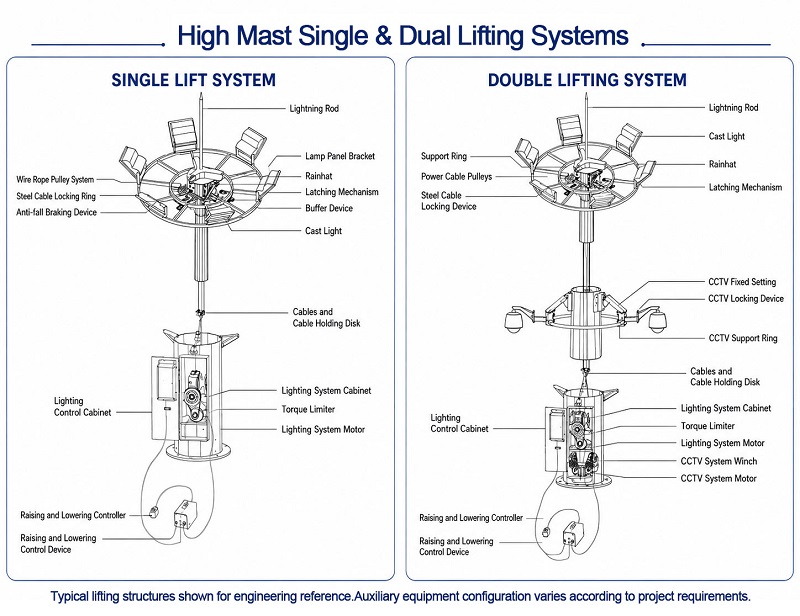
A dual-lifting architecture can provide independent lifting functions for different equipment groups. In a typical project configuration, the lighting platform can use its own lifting mechanism, while a second lifting system can be configured for compatible monitoring or auxiliary equipment where required.
This separation allows different equipment systems to be serviced according to their own maintenance requirements instead of treating all high-mounted devices as one single platform.
For routine inspection or luminaire replacement, the relevant platform can be lowered toward a more accessible maintenance position according to the lifting design.
Pole height, LED quantity, lifting arrangement, auxiliary equipment, control system, and safety configuration can be customized according to the actual project.
Product Parameters
| Parameter | Specification |
| Product Type | Dual-Lift High Mast Light |
| Models | BDGG-0020 / BDGG-0021 / BDGG-0022 |
| Light Source | LED Floodlight |
| Lighting Type | Large-Area High Mast Lighting |
| Pole Height | Project-Specific |
| Pole Material | High-Quality Steel |
| Surface Treatment | Hot-Dip Galvanized Anti-Corrosion Treatment |
| LED Quantity | Project-Configurable |
| LED Power | Project-Configurable |
| Lighting Platform | Liftable |
| Lifting Architecture | Dual-Lift / Project-Specific |
| Lighting System Drive | Motor & Winch |
| Auxiliary Equipment Lift | Optional / Project-Specific |
| Steel Wire Rope | Integrated Lifting System |
| Pulley System | Steel Cable & Power Cable Pulleys |
| Latching Mechanism | Available |
| Cable Locking Device | According to System Configuration |
| Torque Limiter | Available According to Lifting System |
| Braking / Fall Protection | Configurable |
| Raising & Lowering Control | Dedicated Controller |
| Lighting Control | Local / PLC-Based / Project-Specific |
| Foundation | Engineering Design |
| Customization | Available |
Note: The dual-lift technical drawings show representative lighting and auxiliary-equipment lifting arrangements. Final platform quantity, auxiliary devices, winch configuration, safety components, and controls are determined according to the individual project.
Product Details
1. Dual-Lifting Architecture
The dual-lift system is designed to separate the lifting requirements of different high-mounted equipment groups.
A typical configuration can use one lifting mechanism for the main lighting platform and another independent mechanism for compatible monitoring or auxiliary equipment.
This allows each system to be raised, lowered, controlled, and maintained according to its own operational requirements.
2. Liftable LED Lighting Platform
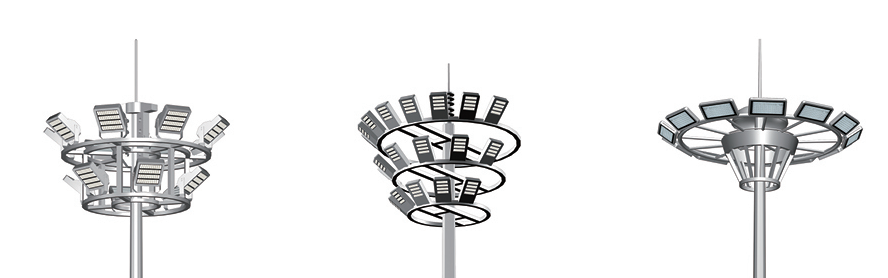
The main lighting platform supports multiple LED floodlights for large-area illumination.
When maintenance is required, the platform can be lowered through the lifting mechanism, providing easier access to:
LED luminaires, mounting brackets, electrical connections, cables, and other serviceable components.
The number and arrangement of LED floodlights can be selected according to mast height, required illuminance, lighting uniformity, and project layout.
3. Motor & Winch Drive System
The lifting mechanism uses a motor and winch to provide the mechanical force required to raise and lower the platform.
The lifting system can include a dedicated:
Lighting System Motor
Lighting System Winch
Torque Limiter
The final motor and winch configuration should be selected according to the mast height, lifting load, platform weight, and engineering design.
4. Steel Wire Rope & Pulley System
Steel wire ropes and pulley assemblies transmit the lifting force between the drive system and the elevated platform.
The reference lifting structure includes:
Steel Cable Pulleys
Power Cable Pulleys
Wire Rope System
Cable Holding Disk
These components guide platform movement and organize the lifting and electrical cable paths within the system.
5. Latching & Locking Mechanism
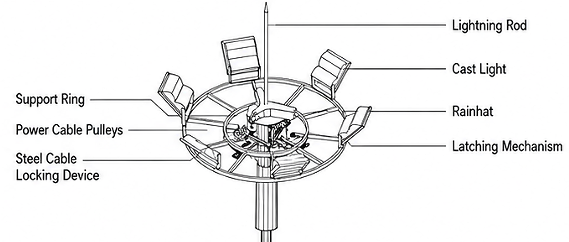
When the platform reaches its normal operating position, mechanical latching and locking components can secure the upper assembly according to the selected lifting-system design.
Reference components include:
Latch Barrel
Latching Mechanism
Steel Cable Locking Device
Position / Red-Flag Indicator
These components form part of the positioning and maintenance-safety strategy of the High Mast Lifting System.
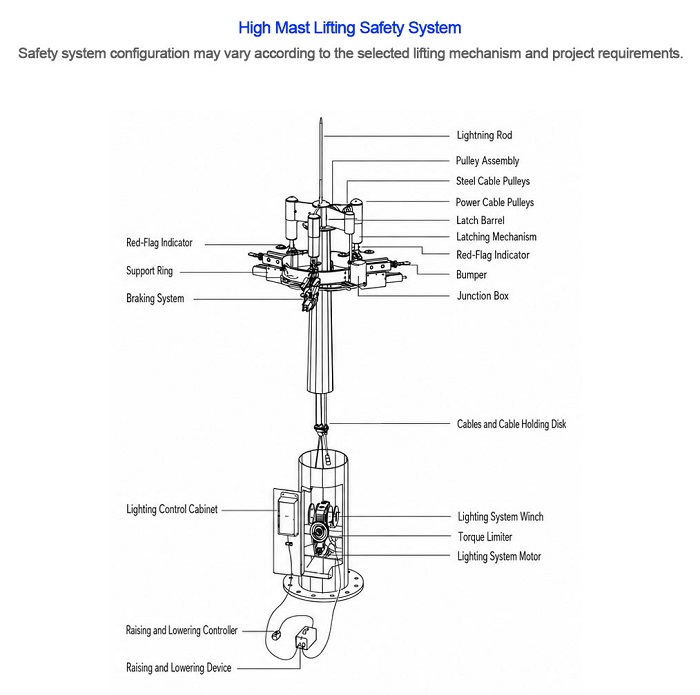
6. Fall Protection & Braking System
High mast lifting requires more than simply moving a platform up and down.
The reference safety design incorporates mechanical protection components intended to support controlled raising, lowering, positioning, and maintenance.
Depending on the project configuration, these can include:
Braking System
Anti-Fall Device
Bumper
Cable Locking Components
Latching Mechanism
7. Raising & Lowering Control
The lifting mechanism can be operated through a dedicated raising and lowering controller.
This gives maintenance personnel a defined operating interface for platform movement rather than relying on uncontrolled manual lifting methods.
The system can include:
Raising and Lowering Controller
Raising and Lowering Control Device
Final operating procedures should follow the project-specific technical and safety documentation.
8. Lighting Control Options
The High Mast Lighting System can be configured with local or centralized lighting control according to project requirements.
For multi-mast projects, a PLC-based architecture can connect individual lighting controllers with a central control platform through the project network.
This allows multiple high mast lighting points to be managed within one coordinated control system.

Dual-Lift System Components
| Component | Function |
| LED Lighting Platform | Supports high-mounted floodlights |
| Auxiliary Equipment Platform | Supports compatible project equipment where required |
| Motor | Provides lifting drive |
| Winch | Raises and lowers the platform |
| Steel Wire Rope | Transfers lifting force |
| Cable Pulleys | Guides steel and power cables |
| Latching Mechanism | Secures operating position |
| Cable Locking Device | Supports lifting-system safety |
| Torque Limiter | Helps protect lifting drive |
| Braking / Fall Protection | Provides lifting safety protection |
| Raising & Lowering Controller | Platform operating control |
| PLC Lighting Control | Optional centralized lighting management |
Features & Benefits
1. Independent Lifting Functions
Dual-lift architecture can provide separate maintenance movement for lighting and compatible auxiliary equipment.
2. Ground-Level Maintenance Access
Liftable platforms can reduce the amount of routine servicing performed at full mast height.
3. Motorized Winch System
Dedicated motors and winches provide controlled platform raising and lowering.
4. Structured Cable Transmission
Steel wire ropes and pulley assemblies guide the lifting system and organize platform movement.
5. Mechanical Locking & Positioning
Latching and locking components support secure positioning at the normal operating height.
6. Fall Protection Capability
Braking and anti-fall components can be incorporated according to the lifting-system design.
7. Centralized Lighting Control
PLC-based control can be configured for projects with multiple high mast lighting points.
8. Project-Specific Engineering
Mast height, lighting platform, auxiliary equipment, lifting loads, safety system, LEDs, controls, and foundation can be customized according to the project.
High Mast Maintenance Sequence
1. Prepare the System
Switch the lighting and lifting system to the specified maintenance condition.
2. Release the Latching Mechanism
Operate the locking system according to the lifting procedure.
3. Lower the Required Platform
Use the dedicated motor, winch, steel wire rope, and controller to lower the selected lighting or equipment platform.
4. Perform Inspection & Maintenance
Inspect luminaires, cables, brackets, electrical connections, mechanical components, and related equipment.
5. Raise the Platform
Return the platform to its designed operating position.
6. Lock & Verify
Confirm the latching, positioning, and safety status before returning the system to normal operation.
Installation and lifting operations should always follow the project-specific technical manual and safety procedure.
Product Applications
1.Large Urban Roads
2.City Squares
3.Ports & Logistics Areas
4.Industrial Yards
5.Transportation Hubs
6.Large Public Facilities

FAQ
Q1: What does “dual-lift” mean in a high mast lighting system?
A1: A dual-lift configuration can provide separate lifting mechanisms for the main lighting platform and compatible auxiliary equipment, allowing different systems to be maintained independently according to project requirements.
Q2: How is the lighting platform raised and lowered?
A2: A typical system uses an electric motor, winch, steel wire ropes, pulley assemblies, latching components, and a dedicated raising and lowering controller.
Q3: What safety devices can be included in the lifting system?
A3: Depending on the configuration, the system can incorporate braking devices, anti-fall mechanisms, cable locking components, latching mechanisms, torque limiters, buffers, and position indicators.
Q4: Is CCTV included as standard in the Dual-Lift High Mast Light?
A4: No. CCTV shown in some engineering diagrams represents an optional auxiliary-equipment configuration. Monitoring equipment and the secondary lifting platform are configured according to the individual project.
Q5: Can multiple high mast lights be centrally controlled?
A5: Yes. A PLC-based lighting control architecture can be configured to connect multiple lighting controllers to a central management platform according to the electrical and control requirements of the project.

Our Factory
Founded in 2000, Baode Lighting Group Co., Ltd. is a professional Outdoor Lighting Manufacturer specializing in LED Street Lights, Solar Street Lights, Smart Poles, High Mast Lights, Lighting Poles and customized lighting solutions.
With integrated capabilities in R&D, product design, manufacturing, engineering implementation and technical support, Baode provides reliable outdoor lighting products for Municipal Projects, transportation infrastructure, commercial applications and Smart City developments worldwide.
Our modern manufacturing facilities are equipped with advanced production equipment, professional testing systems and experienced technical teams. From material selection and component processing to assembly and final inspection, every production stage follows strict quality control procedures to ensure consistent product performance and reliability.
With over 20 years of industry experience, Baode supports OEM and customized Lighting projects, providing flexible solutions based on different application environments, technical requirements and project specifications.
Committed to innovation, quality and long-term partnerships, Baode Lighting continues to deliver efficient and durable lighting solutions for global customers.

Our Certificates
Baode Lighting implements strict quality control standards throughout product development, manufacturing and inspection processes. Our lighting products undergo professional testing procedures to ensure safety, reliability and stable performance for different application environments.
Through continuous improvement of manufacturing processes and product quality management systems, Baode provides dependable Outdoor Lighting Solutions that meet the requirements of global markets and infrastructure projects.
Our certifications and test reports demonstrate our commitment to product quality, technical reliability and compliance with international standards, supporting customers with confidence in long-term cooperation.

 RELATED
 RELATED

Leave your question and we will
respond and reply to you promptly.


Copyright © Baode Lighting Group Co., Ltd. All rights reserved record number:SuICP No. 20011226 sitemap
Technical Support: Yicheng Network Disclaimers
Deze website maakt gebruik van cookies om ervoor te zorgen dat u de beste ervaring op onze website krijgt.


